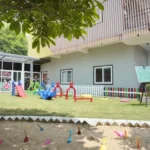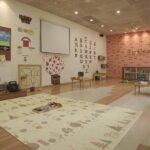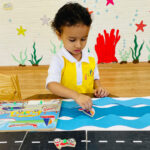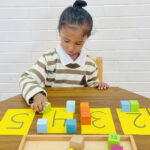
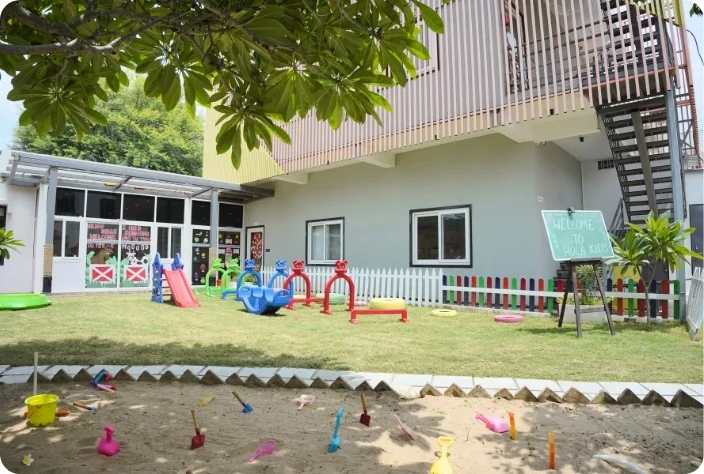
Environment at Holakids is such that when you enter it, it communicates a sense of vitality. It is open, airy and clean. Materials are at child level, colorful, orderly and accessible. This makes our true values – image of the child truly explicit.
Setting up the environment I keep asking the following questions to myself and my fellow educators
- Are you trying to protect the children from putting things in their mouths by having only large objects available to smallest children?
- Are the doors closed when the children are in the room to prevent them from roaming off?
We strongly believe that it is possible to help the children discover and respect the dangers inherent in all environments and to stay aware of these for their own protection. There is no way to completely prevent accidents.
Environment at Holakids.
There is no shortcut to creating an enticing environment. It is like our home, a place where we spend good time to choose furniture and decorations. Our vision and view of the child are reflected in our environment. When I look around the school and examine each detail carefully I observe that Holakids, a preschool in Udaipur makes it the best play based school because it has an environment for both adults and children, its engaging. The kind of toys whether Montessori or engaging toys all are hand-picked, games and books we have in our classes are just so good and engaging. The classes are cleaned and organized. The house play area is thematically created. There are game tables in the classrooms. A substantial area for construction, reading and art makes Holakids a unique preschool in Udaipur. All the materials from the documentation panels, to progress charts in classrooms, bulletin boards for parents are all simple but real.
Environment as Third Teacher.
The environment is an active participant in learning—it should invite curiosity, engagement, and exploration.
Once you see your environment as the third teacher, you’ll realize how much it could communicate, provoke thinking, and guide children’s exploration—not just through your words, but through the way the space is intentionally designed.
This phrase means that environment should support the work and interest of the children without constant adult guidance and intervention. Environment should encourage children to work in the spaces and groups and it should be like a fuel to children’s minds.
Continuity and change.
At Holakids attention is given to what needs to stay and what needs to be changes inorder to make the room for new students to live there in more engaging manner.
The room on our first floor was initially the space for the parents to come and interact with us and it had also been used for musical instruments by the group of children of nursery class. Later on thi s area developed into the story telling area with puppets and that theatre set-up. Also at Holakids wqe have noticeable tracks of previous students all over the school in the form of projects and their products, which still inhabit the school.
Apart from this every piece of furniture is moved, every toy is washed, every surface is wiped. The school is cared and cleaned at regular intervals. Holakids when it come to hygiene and cleaning is treated as one would treat his own home environment. These ties directly into the Reggio and Montessori view of children and sort of environment they merit.
Conclusion
When I think about the environment in which I work I have an answer yes to all below
Furniture is child-sized, welcoming and cared for.
Real life instruments are available for pretend plays.
Wooden pieces available for construction
The mirrors, musical instruments, Window covers, fabrics, colors make the whole environment engaging.
Hence with all this we stimulate the child individually and also in groups.